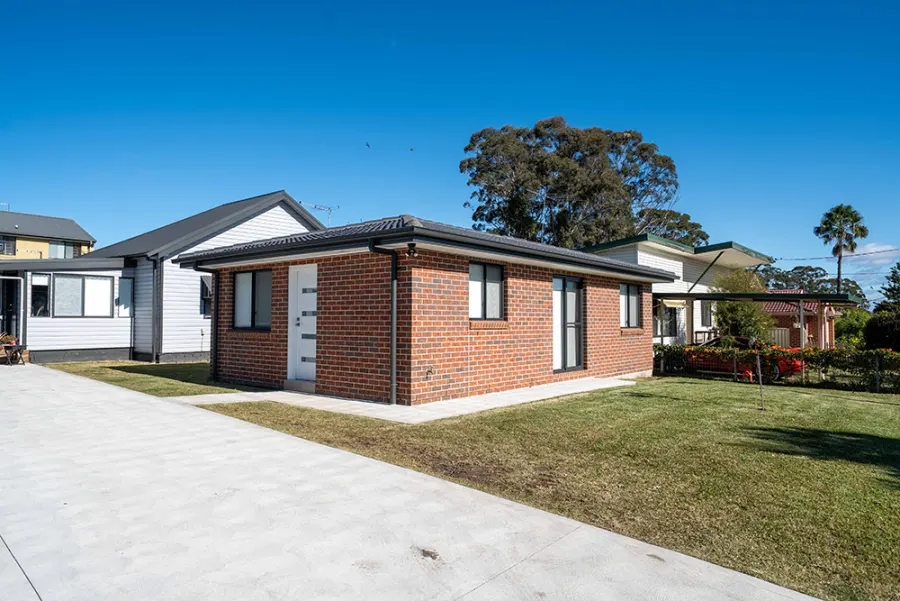
- An estimated 3.6 million Australian lots are large enough to add a secondary dwelling — most owners don’t know it.
- State governments across NSW, Victoria and Queensland have overhauled granny flat planning rules to fast-track approvals and ease the housing supply crisis.
- Multigenerational living is surging — families are using granny flats to keep relatives close without giving up independence.
- In NSW, eligible blocks can be approved via CDC in as little as 10 days. No DA. No lengthy council process.
- 5 Star Granny Flats has over 15 years of experience building in Sydney — and a free site inspection to get you started.
A Quiet Shift in Suburban Australia
Something is changing in the Australian suburb. It’s not new apartment towers. It’s not large-scale rezoning. It’s happening quietly, in backyards — one secondary dwelling at a time.
Granny flats have moved from a niche accommodation solution to a mainstream property strategy. Sisters Monica and Nola McKay — downsizing together in regional Victoria — represent one version of the trend: two family members sharing a property on their own terms, one in the main house, one in the flat out back. But across Sydney, Brisbane, Melbourne and beyond, thousands of homeowners are making the same calculation for very different reasons.
Some are adding rental income. Some are housing adult children who can’t afford the market. Some are keeping ageing parents close. Some are simply making their property work harder in a climate where buying a second block is out of reach. The granny flat, long dismissed as a backyard afterthought, has quietly become one of Australia’s most versatile housing tools.
What’s Changed with Planning Rules
The surge in granny flat builds isn’t happening by accident. State governments across Australia have recognised secondary dwellings as one of the fastest, cheapest ways to add housing supply without rezoning suburbs or fast-tracking large-scale development.
The results have been significant:
- NSW: Under the Housing SEPP 2021, granny flats up to 60sqm can be approved via Complying Development Certificate (CDC) on eligible residential lots. The CDC pathway bypasses council entirely, with a private certifier approving eligible builds in as little as 10 business days. The government has also expanded the types of lots that qualify, meaning more homeowners in Sydney and regional NSW can now access the fast-track route.
- Victoria: Amendment VC253, introduced in December 2023 and now fully operational in 2026, removed the planning permit requirement for secondary dwellings under 60sqm on most residential lots. This alone saves homeowners thousands in application fees and months of waiting.
- Queensland: The Queensland Housing Code commenced in September 2026, setting a state-level standard for secondary dwellings with a 50sqm internal floor area threshold (60sqm on lots of 1,000sqm or more), giving councils a clear framework during the transition period.
The direction of travel is clear. Across every major state, planning reform is making it easier, faster, and cheaper to add a secondary dwelling to an existing property. The political and housing crisis pressures that produced these reforms aren’t disappearing.
If your block is 450sqm or more with a 12-metre frontage, there’s a very good chance you qualify for the CDC pathway. That means no DA. No council submission. A certifier can have you approved and ready to build in as little as 10 days. 5 Star Granny Flats manages the entire approval process — and guarantees it in 4 weeks.
3.6 Million Lots. One Opportunity.
Research cited in the AFR’s reporting on suburban housing density put the number of eligible lots across Australia at approximately 3.6 million. That’s 3.6 million backyards where a secondary dwelling could, in principle, be built — adding housing supply without touching greenfield land, without new infrastructure corridors, without large-scale capital investment.
This is what planners mean when they talk about “gentle density” or “backyard densification.” It doesn’t require rezoning. It doesn’t require government-owned land. It requires individual homeowners to understand that their block already has a second home in it — they just haven’t built it yet.
The catch is that most of those 3.6 million homeowners don’t know they’re sitting on that potential. They assume the process is complicated, expensive, slow. And it used to be. The planning reforms of the last three years have changed that calculation dramatically — particularly in NSW.
“Hundreds of thousands of existing suburban lots could accommodate a granny flat, highlighting the real potential of backyard densification.”
Master Granny Flats Research, 2026
The Multigenerational Living Surge
Not every granny flat is built for rental income. A growing share of Australian homeowners are building them because the alternative — putting a parent in aged care, or watching an adult child pay $600 a week for a share house — is worse.
The multigenerational living trend accelerated through the pandemic and has not slowed. The case for it is straightforward: a secondary dwelling on the same block gives family members proximity without sacrificing privacy or independence. The main house stays the main house. The granny flat is a full self-contained home — its own kitchen, bathroom, living area, separate electricity meter — within a shared property boundary.
New research conducted for investment platform Sharesies found that 50% of more than 1,000 Aussie parents with kids under 18 are anxious their children will struggle to get their own home. A granny flat doesn’t solve the housing affordability crisis. But for families who own a qualifying block, it can offer a practical bridge — and it can do it now, not in a decade.
What This Means for NSW Homeowners
In NSW, the conditions for building a granny flat have never been more favourable. The planning pathway is clearer. The approval process is faster. And the demand — from renters, from family members, from the market in general — has never been higher.
Here’s the eligibility checklist for the CDC pathway in NSW:
- Block size of at least 450sqm
- Minimum 12-metre frontage
- 3-metre setback from rear boundary
- 0.9-metre setback from side boundaries
- Adequate clearance from trees over 6 metres (at least 3 metres)
- No relevant flood, bushfire, or heritage overlays
If your block ticks those boxes, you’re almost certainly eligible. And if you’re not sure, a free site inspection from 5 Star Granny Flats will tell you in a single visit.
One detail that isn’t widely known: if your lot is over 450sqm, you can actually build both a 60sqm granny flat AND a 36sqm studio under NSW’s complying development rules — as long as your main dwelling is already on the block. Two secondary dwellings. Two additional income streams. One approval process.
How to Act on It
The conversation around granny flats in Australia has shifted from “can I build one?” to “why haven’t I built one yet?” The planning reform is done. The demand is there. The return on investment is compelling. What’s left is execution.
5 Star Granny Flats has been doing exactly this for over 15 years in Sydney. They’re not a referral service or a middleman. They’re an award-winning builder with a display home in Blacktown and 26 CDC-ready designs to suit every block and budget. Every build comes with:
- A free site inspection and eligibility check
- A 4-week approval guarantee
- Full project management from consultation to handover
- 6-year structural warranty
- Separate electricity meter as standard
- Floor-to-ceiling tiled bathrooms and quality inclusions throughout
The housing density conversation in Australia’s suburbs is already underway. The question is whether you’re watching it happen from the footpath — or from the income stream in your backyard.
Frequently Asked Questions
A granny flat (formally called a secondary dwelling in NSW planning legislation) is a self-contained residential unit located on the same lot as a principal dwelling. It has its own kitchen, bathroom, bedroom(s), and living area, but shares a land title with the main house and cannot be sold separately. In NSW, granny flats can be either attached to or detached from the main home, though detached builds are typically more cost-effective.
A combination of factors has driven the surge: record-low rental vacancy rates, rising property prices making second-property investment increasingly difficult, planning reforms across NSW, Victoria and Queensland that fast-track approvals, and a cultural shift toward multigenerational living. The granny flat addresses multiple pressures at once — housing supply, rental income, and family accommodation — making it one of the most versatile property strategies available to existing homeowners.
Research cited in 2026 AFR reporting estimated approximately 3.6 million Australian lots are large enough to accommodate a secondary dwelling. The vast majority of these homeowners have not yet acted on that potential, either because they don’t know they’re eligible or because the planning process previously seemed too complicated. Recent reforms have significantly simplified that process, particularly in NSW.
NSW expanded the CDC (Complying Development Certificate) pathway under the Housing SEPP 2021, allowing eligible builds to be approved by a private certifier in as little as 10 days without council involvement. Victoria removed the planning permit requirement for secondary dwellings under 60sqm on most residential lots via Amendment VC253 (now fully operational in 2026). Queensland’s Queensland Housing Code commenced in September 2026, providing a state-level standard that gives councils a clearer framework for secondary dwelling approvals.
Yes. In NSW, a secondary dwelling can be used for family accommodation and then rented on the open market to any tenant at any time. There’s no restriction on who can occupy it or how the use changes over the life of the property. Many homeowners build for a family member initially and transition to rental income later.
Yes, typically significantly. A well-built granny flat in Sydney generally adds $150,000–$280,000 to a property’s market value, according to 2026 industry data. The uplift reflects both the structural addition and the dual-income appeal the property has to future buyers. Properties with an existing secondary dwelling typically attract investors and owner-occupiers with family members, widening the potential buyer pool.
The maximum internal floor area under the NSW Housing SEPP 2021 is 60 square metres. This does not include unenclosed areas like verandahs, decks, or carports, which can be added to increase the practical living space without affecting your approval. 5 Star Granny Flats optimises every design within the 60sqm footprint to maximise tenant appeal and liveability.
Under NSW’s complying development rules, eligible lots over 450sqm can accommodate both a 60sqm granny flat and a 36sqm studio — provided there is already a principal dwelling on the block. That means two additional dwellings, two potential income streams, and one approval process. This is a lesser-known provision that 5 Star Granny Flats can help you navigate.